Endometriosis
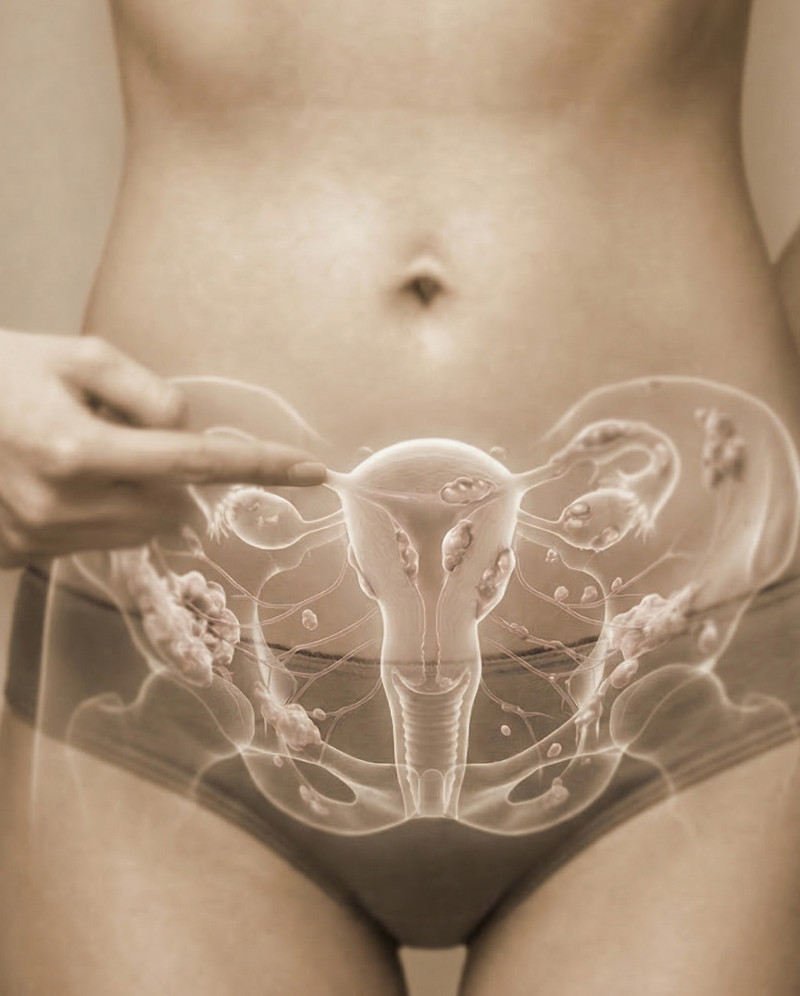
Endometriosis is a chronic condition in which tissue similar to the lining of the uterus (endometrium) grows outside the uterus. It affects 1 in 10 women and is frequently associated with adenomyosis (the presence of endometrial-like tissue within the muscular wall of the uterus), which coexists in approximately 30% of cases.
- Key Symptoms: Severe menstrual pain, pain during sexual intercourse, abdominal or pelvic pain, and infertility.
- The Challenge: Diagnosis is delayed by an average of 10 years, as small endometriotic lesions may not be visible on MRI or ultrasound. This delay can contribute to chronic fatigue and a significant reduction in quality of life.
- Treatment Options: Depending on the patient's age, fertility goals, and symptoms, treatment may involve conservative management (dietary modifications, hormonal therapy, etc.) or surgical intervention (laparoscopic or robotic surgery for diagnosis and complete excision of endometriotic lesions), with the aim of preserving fertility and organ function.
Understanding Endometriosis: Pathophysiology and Clinical Phenotypes
As a systemic inflammatory disease, endometriosis presents in three main forms: superficial peritoneal endometriosis, ovarian endometriomas (commonly known as "chocolate cysts"), and Deep Infiltrating Endometriosis (DIE). The latter represents one of the most complex forms of the disease, as it can infiltrate vital structures, including the bowel, ureters, and pelvic nerves.
Modern diagnostic assessment relies on transvaginal ultrasound and expert clinical evaluation. At our center, treatment is focused on improving our patients' quality of life and, when clinically indicated, achieving complete excision of endometriotic lesions using advanced nerve-sparing surgical techniques. Our goal is to achieve the best possible outcomes, even in the most challenging cases, such as a frozen pelvis.
Surgical management of such complex cases can particularly benefit from the expertise of specialist gynecologic oncologists with extensive experience in technically demanding surgical procedures. Advanced endometriosis surgery may require a level of surgical precision and expertise comparable to that involved in complex oncological operations.
Living with Endometriosis: The Importance of Early Diagnosis
Many women suffer in silence, believing that severe menstrual pain is simply "normal." In reality, endometriosis can affect almost every aspect of daily life, from professional activities and emotional well-being to sexual health and fertility.
It is also important to recognize that endometriosis does not always cause symptoms. In some cases, the condition is discovered incidentally during surgery performed for an unrelated medical reason.
We understand that every patient's experience is unique. Under the guidance of Dr. Georgios Gitas, our priority is early diagnosis and effective symptom management to improve each patient's quality of life.
When surgical treatment is necessary, we use state-of-the-art robotic technology to provide comprehensive surgical treatment while minimizing postoperative pain and promoting a faster recovery. Our aim is to help patients regain control of their health, well-being, and everyday lives.
About Dr. Georgios Gitas
Dr. Georgios Gitas served for several years as Head of the Endometriosis and Endoscopy Center at the University Hospital Schleswig-Holstein (UKSH), Lübeck, Germany, where he specialized in treating some of the most complex and advanced forms of endometriosis.
These included deep infiltrating endometriosis involving the pelvic nerves, bowel, ureters, and urinary bladder, as well as frozen pelvis, diaphragmatic endometriosis, and other challenging presentations of the disease.
His surgical approach has consistently focused on minimally invasive endoscopic techniques, including laparoscopic and robotic surgery, combined with specialized procedures such as nerve-sparing surgery and laser-assisted techniques.
Dr. Gitas continued his work in the treatment of patients with endometriosis during his tenure as Head of the Gynecology Center at Charité University Hospital, Campus Mitte, Berlin. Charité was ranked the leading hospital in Europe and fifth worldwide in 2022.
Dr. Gitas currently serves as Director of the Department of Gynecologic Oncology and Robotic Surgery at the Interbalkan Medical Center of Thessaloniki, Greece.
Scientific Publications by Dr. Georgios Gitas
Selected publications in international peer-reviewed medical journals focusing on endometriosis and minimally invasive gynecologic surgery:
- https://pubmed.ncbi.nlm.nih.gov/33728657/
- https://pubmed.ncbi.nlm.nih.gov/34109767/
- https://pubmed.ncbi.nlm.nih.gov/34977146/
- https://pubmed.ncbi.nlm.nih.gov/33440062/
- https://pubmed.ncbi.nlm.nih.gov/34084520/
- https://pubmed.ncbi.nlm.nih.gov/34989636/
- https://pubmed.ncbi.nlm.nih.gov/34585638/
- https://pubmed.ncbi.nlm.nih.gov/33536066/
- https://pubmed.ncbi.nlm.nih.gov/33078642/
- https://pubmed.ncbi.nlm.nih.gov/33080919/
- https://pubmed.ncbi.nlm.nih.gov/32488399/
- https://pubmed.ncbi.nlm.nih.gov/34954814/
- https://pubmed.ncbi.nlm.nih.gov/32762476/
- https://pubmed.ncbi.nlm.nih.gov/35263843/